
Conversion Chart for Flour
How much does a cup of flour weigh? It depends on the flour and how you fill the cup. This conversion chart gives typical weights for common flours in cups, tablespoons, grams and ounces, explains the spoon-and-level method, and comes as a printable kitchen chart with a baking conversion workbook.
- Instant download
- Editable Excel & Word
- Print-ready PDF
- 7-day refund
4 files · PDF, XLSX, DOCX
Flour & Baking Conversion Charts
Printable flour conversion chart for 12 flours, a full baking conversion chart, an Excel recipe converter and scaler, and a dual-measure recipe card.
- Flour conversion chart (PDF, XLSX)
- Baking conversion chart (PDF)
- Recipe converter (XLSX)
- + 1 more
$5.00 USD, one-time 4 files · about $1.25 each
- Instant download
- 7-day refund
- Secure checkout by Stripe
7-day money-back guarantee. Full refund within 7 days of purchase, even after you download.
Free sample: Flour Conversion Chart (PDF, 107 KB)
Flour & Baking Conversion Charts
Printable flour conversion chart for 12 flours, a full baking conversion chart, an Excel recipe converter and scaler, and a dual-measure recipe card.
- Flour conversion chart (PDF, XLSX)
- Baking conversion chart (PDF)
- Recipe converter (XLSX)
- Recipe card (DOCX, PDF)
Formats: PDF, XLSX, DOCX. Instant download after payment (link valid 72 hours, up to 5 downloads). AI-assisted: the templates were drafted with AI help and reviewed and laid out before publishing.
$5.00 USD, one-time 4 files · about $1.25 each
- Instant download
- 7-day refund
- Secure checkout by Stripe
7-day money-back guarantee. Full refund within 7 days of purchase, even after you download.
Free sample: Flour Conversion Chart (PDF, 107 KB)
Full refund within 7 days — see the refund policy and license.
Free printables
Single sheets you can print right now, no sign-up. The full pack adds every sheet in one download plus the editable files.
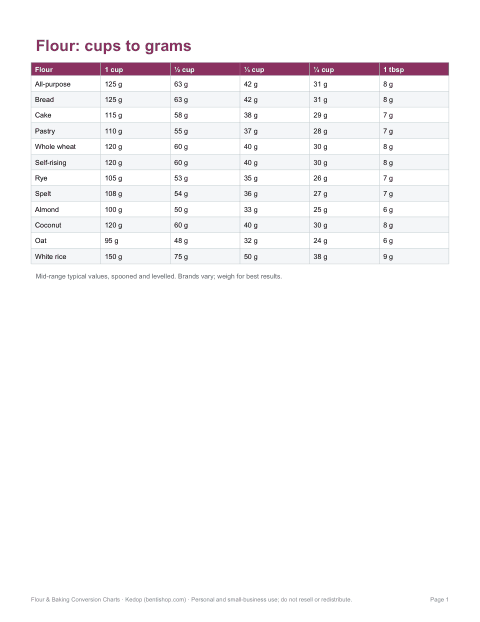
 Printable Flour Conversion Chart
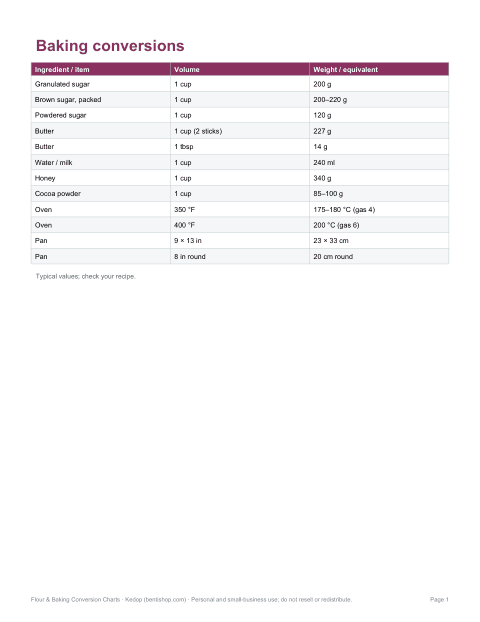
 Printable Baking Conversion Chart
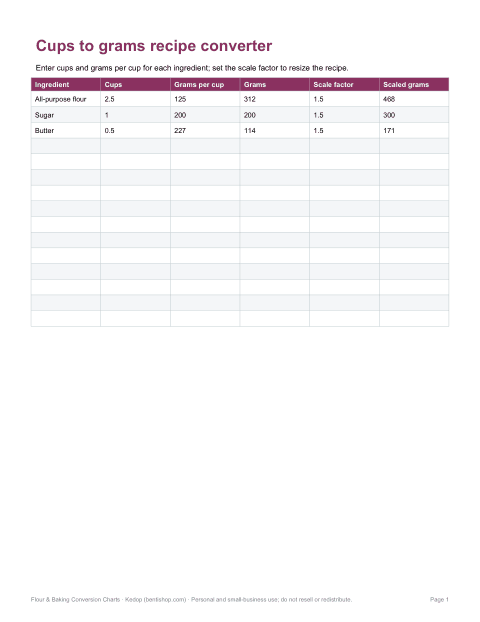
 Printable Flour Recipe Conversion Chart
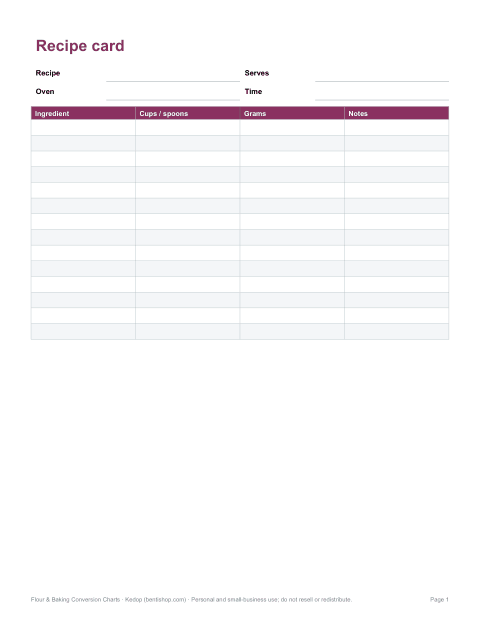
 Printable Flour Conversion Chart Recipe Card
Flour conversion chart: 1 cup in grams
| Flour | Grams per US cup (spooned and levelled) | Ounces per cup |
|---|---|---|
| All-purpose (plain) | 120–125 g | 4.25–4.4 oz |
| Bread flour | 120–130 g | 4.25–4.6 oz |
| Cake flour | 110–120 g | 3.9–4.2 oz |
| Pastry flour | 105–115 g | 3.7–4.1 oz |
| Whole wheat | 115–130 g | 4.1–4.6 oz |
| Self-rising | 115–125 g | 4.1–4.4 oz |
| Rye flour | 100–110 g | 3.5–3.9 oz |
| Spelt flour | 100–115 g | 3.5–4.1 oz |
| Almond flour | 95–112 g | 3.4–4 oz |
| Coconut flour | 110–128 g | 3.9–4.5 oz |
| Oat flour | 90–100 g | 3.2–3.5 oz |
| White rice flour | 140–160 g | 4.9–5.6 oz |
Published weights differ between baking references and flour brands because of milling, moisture and how the cup is filled. Many recipe writers use 120 g or 125 g for a cup of all-purpose flour. When a recipe gives both cups and grams, trust the grams.
Cups to grams for all-purpose flour
| Cups | At 120 g/cup | At 125 g/cup |
|---|---|---|
| ⅛ cup (2 tbsp) | 15 g | 16 g |
| ¼ cup | 30 g | 31 g |
| ⅓ cup | 40 g | 42 g |
| ½ cup | 60 g | 63 g |
| ⅔ cup | 80 g | 83 g |
| ¾ cup | 90 g | 94 g |
| 1 cup | 120 g | 125 g |
| 1½ cups | 180 g | 188 g |
| 2 cups | 240 g | 250 g |
| 3 cups | 360 g | 375 g |
| 4 cups | 480 g | 500 g |
One tablespoon of all-purpose flour weighs about 7.5–8 g and one teaspoon about 2.5–2.6 g.
Why weighing flour is more accurate
A cup of flour scooped straight from the bag can weigh 140–150 g because the flour is packed into the cup, while flour spooned in and levelled weighs about 120–125 g. That difference of 20% or more is enough to turn a tender cake dry or a soft cookie cakey. A digital kitchen scale removes the guesswork, is faster once you are used to it, and means fewer measuring cups to wash. Professional and many modern recipes are written by weight for this reason.
How to measure flour by volume
- Stir or fluff the flour in its container to loosen it.
- Spoon flour lightly into the measuring cup until it overflows; do not shake or tap the cup.
- Level off the top with the straight edge of a knife.
- For sifted flour, sift first, then spoon into the cup — “1 cup sifted flour” is lighter than “1 cup flour, sifted”.
Use dry measuring cups (the kind you fill to the brim) for flour, not a liquid measuring jug.
UK, Australian and metric cups
A US cup is about 237 ml (often rounded to 240 ml). Australian and many metric recipes use a 250 ml cup, which holds about 5% more flour. The old UK imperial cup was about 284 ml, but most British recipes use grams. If a recipe comes from another country, check which cup it assumes, or better, use its gram measurements.
Substituting flours
- Cake flour: for 1 cup, use 1 cup all-purpose minus 2 tablespoons, plus 2 tablespoons cornstarch, sifted together.
- Self-rising flour: for 1 cup, use 1 cup all-purpose plus 1½ teaspoons baking powder and ¼ teaspoon salt.
- Bread flour: all-purpose can usually replace it, giving a slightly softer crumb.
- Whole wheat: replace up to about half of all-purpose flour; it absorbs more liquid.
- Almond and coconut flour are not one-to-one substitutes for wheat flour; coconut flour in particular absorbs much more liquid. Use recipes developed for them.
What is in the printable pack
- Flour conversion chart — cups, tablespoons, grams and ounces for 12 flours, sized for a cupboard door or fridge.
- Baking conversion chart — sugar, butter, liquids, oven temperatures and pan sizes.
- Recipe converter workbook (Excel) — enter cups and flour type to get grams; scale recipes up or down.
- Recipe card template with columns for both volume and weight.
Who it is for
Home bakers converting American recipes, bakers moving from cups to a scale, cooking teachers and anyone who wants a quick-reference chart in the kitchen.
Formats
Charts are print-ready PDFs (US Letter; they print on A4); the converter is an Excel workbook with formulas; the recipe card is an editable Word file.
Frequently asked questions
How many grams is 1 cup of flour?
About 120–125 g for all-purpose flour, spooned and levelled.
How many grams is 1 cup of bread flour?
About 120–130 g, depending on brand and method.
How many cups is 500 g of flour?
About 4 cups of all-purpose flour at 125 g per cup.
Is it better to weigh flour?
Yes. Weighing is more accurate and consistent than measuring by volume.
Was AI used to create the charts?
The charts were compiled with AI assistance from typical published values and checked and formatted before publishing. Weights vary by brand; use them as a guide.